En Masse started at the home, in Bookhaus, an independent bookshop for parents, children and everyone in between. I felt nervous approaching its print lined windows, not many people had arrived so there was nowhere to hide the fact that I was alone. Someone stepped outside for a cigarette, perfect, my chance to make a friend through the shared ritual of smoking. I had arrived in Bristol 10 am that morning. 2 buses , 13 hours, one delay and a stopover in London latter I got to my future home. The past 6 months of my musical pilgrimage around the UK had led me here, but once I had arrived at the end it was hard to know where to start. Even though Bristol is a small city it feels like a tiny world, occupying a special place in the solar system, you get caught in its gravitational pull, ending up somewhere that is a universe of boundless possibility, both exciting and incredibly overwhelming.
I decided that the best way to feel like I belonged in Bristol was to throw myself at it. I start rolling a cigarette outside Bookhaus ‘Are you here for the talk?’ I ask the guy who introduces himself as Tom. ‘I’m volunteering for En masse’ he says ‘oh nice, but sorry can you tell me what it actually is?’. On the advice of a friend, I had bought tickets for the Friday night event, not realising it was a part of a wider music and arts festival. Bristol’s creative scene is an ecosystem of symbiotic relationships; each element cannot be considered independently of the other. En masses program represented a bridge between these different limbs creating a body of creativity that was greater than its individual parts. It was by beautiful coincide that I arrived in Bristol the same day the festival started. It was curiosity that caused me to disregard my lack of sleep and drag myself out for its first event, an author talk with Dhanveer Singh Brar about his new book on Gil Scott-Heron.
Reading out a passage from his book , Dhanveer would pause occasionally to play a song, well, different versions of the same song, sung over different time periods, by artists who all struggled with the same thing. Listen to ‘home is where the hatred’ is by Gill Scott-heron , the Ester Phillips cover and DJ Rashad’s remix, what truth are they speaking to? . Throughout the talk it became clear that songs tell us true stories about the struggles of ordinary people living under extraordinary conditions. Conditions that still exist today. Using music as a device Dhanveer was able to travel through time, bringing the past into the present.
Book Haus, an institution that reflects Bristol’s radical legacy, was the right place to start a festival that recognizes the areas musical heritage while also celebrating its contemporary culture. In an interview with Resident Adviser (RA) Batu, the festivals founder, acknowledges the nostalgia complex that exists in places with a rich musical history. By looking back, we often forget to look around and appreciate the experimentation that is happening now. En Masse attempts to resolve this conflict by interpreting history through a contemporary lense.
Dance music comes from political resistance – it cannot be considered independently of the marginalised voices that gave rise to its rhythmic beats. When listening to this music it’s important to acknowledge this legacy of activism but understand how the struggle for space is ongoing. Israels continued attacks on Palestine feel very current while being suffused with decades of oppression. En Masse brings awareness to the world through its community and arts programme, which also provides channels for protest. On Wednesday I was introduced to Mickey Zoogs, a cornerstone of Bristol’s underground scene. The back room, normally full of alternative folk sipping on craft drinks and listening to noods radio, was now packed with people interested in how dance music communities can mobilise for Palestine. As cultural performers DJs have a lot of power, with this privilege comes a choice, how do they use it ? The BDS (Boycott, Divest, Sanction) movement asks us to consider how the music industry and its participants unconsciously fund Israel’s atrocities. Boycotts represent one form of consciousness raising where artists use the innate political nature of dance music to become powerful agents of change. As the appreciators, attendees, dancers we are able to participate in this legacy by attending festivals like En Masse .
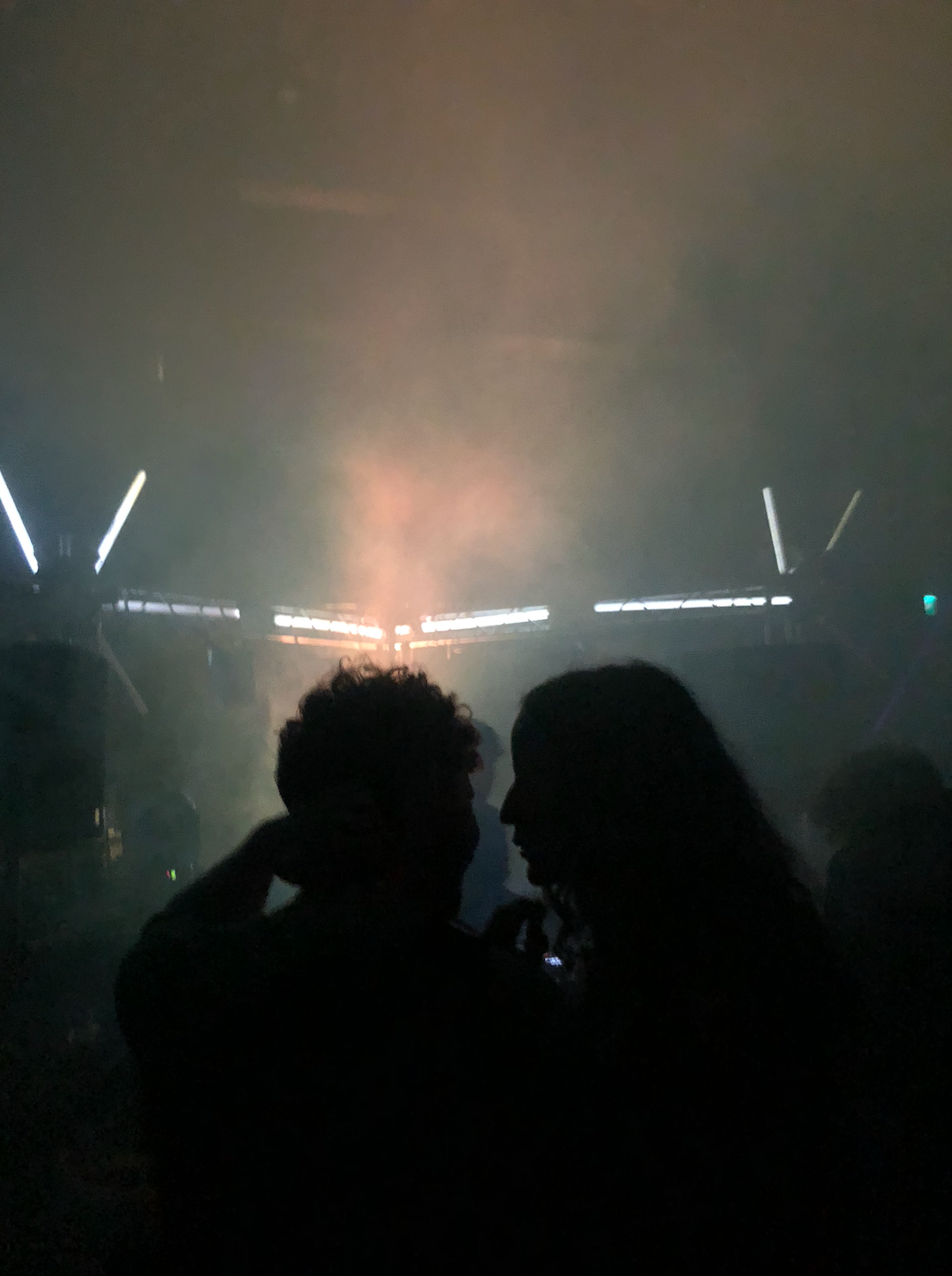
When asked about how to translate political values to a younger generation Batu responds ‘the main thing is hearing music in the right space on a really good soundsystem …making the right conditions for artists and audiences to engage, that’s enough’ a simple response that speaks to the powerful nature of Bristol’s scene, a musical scene that En Masse was guiding me through, its musical programme starting with DOCUMENT on Thursday night. This old file storage facility captures something of the warehouse events that were famous for hiding the underground in plain sight. The curation was incredibly unique, the constant being that all the artists used textual layering and the mix of spoken word with electronic sounds to create a sonic atmosphere that was not just heard but felt. At times the music was incredibly mechanical, heavy bass rattling the exposed air conditioning, contributing to this image of a post-industrial minefield. A deep exhale latter and you would find yourself in a lucid state surrounded by amber lighting and naturalistic noise. The soundscape produced was incredibly intimate, a shared ritual, at times people sat down, legs crossed, eyes closed letting smoke build around them and the moment roll through them. It felt like the musicians were taking you on a journey through dreams and their reality. Coby Set and Continue spoke in visions of a world where we ‘embrace the differences that make us’ but ended the night with a reminder ‘we are only free when Palestine is free’.
In Batus words the current economic conditions are ‘really fucked’ and this impacts the way people interact with culture. In the UK smaller festivals are being absorbed by giant big fish, turning the pond into a blood bath of broken promise. The environment doesn’t feel like one where music and the arts are able to thrive, but the conditions mean that it must. We once lived in a world where the church maintained absolute control over culture and people’s access to it, but through the collective dreams of creatives we now have places like the Trinity Centre (former Holy Trinity Church). On Friday night En masse led me to this community centre, a venue that represents the DIY spirit of Bristol where people transform the past into something they want to be apart of in the present.
Entering the old church, it felt like you had descended into a subterranean world, a space some would call satanic, others a different sort of heaven. You could feel the sound roll through the floor boards underneath as if it was rocking the very foundations of this ancient church. Batu and Tikiman were about to play for the first time together and you could see the curiosity in people’s eyes, we were about to witness a mix of contemporary Bristol and one of its pioneers. Tikimans vocals were hypnotic, at times sounding like a mantra, complemented by Batus bassy sounds that created an almost ritualistic effect. I leant over to my friend and yelled ‘WHAT MUISC IS THIS?’, ‘dub-techno’ he replied, a style that speaks to the roots of sound in Bristol but also pushes boundaries in terms of where it is heading. Their set was infused by emotional depth and technical complexity, providing a love letter of sorts to the scene, a scene that encourages experimentation. Bristol is a city that feels like a small village where you are empowered to create by a supportive network of fellow peers. I was starting see the beautiful ecosystem of Bristol unfold.
Just after I had arrived at Trinity Centre I looked around and saw Tom dancing to my side, the first of many future friends. Throughout the night, standing in the smokers, waiting at the bar, dancing front left I kept seeing other people that I had met over the past four days of En Masse. A collage of connection it painted a powerful picture of music and its ability to bring people together across worlds. Ene masse is actually a French word that means ‘all together and at the same time’, the festival embodies this through its programming which ensures that no two events are on at the same time. The crowd moves as one, everyone undertaking the same journey together, as connection grows you become more involved with the mass.
On Saturday I followed along to my 7th En Masse event at The Cube, a Bristol institution self-described as an ‘atypical arts centre // research site for transient social dream-logics’ behind its worn brick walls was an entire afternoon of discussion about recent pasts and possible futures. Outside there was Caribbean food and stalls selling handmade goods, books , records. Inside the theatre was beautiful, red velvet curtains, thick seats that swallowed you and a speaker stack either side of the stage. I was prepared to spend an entire afternoon here. Paul Purgas talk on music in a post-independence India, resituated electronic music as a powerful tool for nation building in the context of a country that was struggling with its identity. At the time classical music was conservative and electronic sounds provided an emancipatory space where people could break free from these conditions. ‘India was dreaming in the 1960s’, and it is through experimental music that we are able to keep these dreams alive. Kod9’s powerful presentation on sonic terrorism and how sonic booms create an ecology of fear was a harsh reminder that sound can be weaponised with debilitating consequences. His discussion with Mohamed Choucair ,who has turned drone recordings from the IDF into an instrument, created hope by showing us that music can be used to regain control over the very thing that scares us.
Pessimism is everywhere these days. You read about it in the news, articles discussing the death of another grassroots festival, hear it on Spotify, a song that sounds human but is actually AI, watch it in the sets of DJs who are playing to a crowd of phones. It’s easy to get lost in the sea of pessimism, but staying afloat is necessary. Bristol was once known as ‘the graveyard of ambition’ , where good ideas come to die, a vacuum of success, it has now produced some of the most successful artists in the modern scene. At the end of his interview with RA Batu makes the point that ‘optimism is a political choice’ , one that En Masse is making just through existing. With new challenges comes greater opportunity for more creative responses. The death of one thing allows you to entertain dreams of another.
En Masse started in the home and it finished where the heart is – at the Love Inn. An event for friends and family , two things I didn’t have when I arrived in Bristol. The immersive space was a perfect way to end an intimate week and I kept jumping between the outside and inside wanting to both chat about the festival and dance on its last night of music. Next to the booth I ran in Natalie – a girl I had just met the night before at The Island when she offered me a starburst and I gave her some water, gestures by two people who were both by themselves but didn’t feel that way. En Masse had created an environment where you felt like you could go out by yourself because you were surrounded by a mass of like-minded people. Community and the arts together have the radical ability to create a sense of collective belonging, a powerful force in the face of an uncertain future. Despite my nerves on that first day in Bristol, En Masse had introduced me to a city that I was excited to become a part of. My dreams were becoming reality.